Collection Management Software for Museums, Galleries, Archives, and Exhibitions
Archive for Art helps cultural institutions manage collection records, loans, conservation history, digital assets, and public-facing object information in one structured platform. Built for institutional workflows, the system can be configured to your needs, deployed on your own infrastructure or in the cloud, and scaled as your collection grows.
Built for institutions that need structured records, clear oversight, and long-term control over collection data.

Trusted by Institutions and Partners
Archive for Art is designed for organizations that manage valuable collections, documentation, and public-facing cultural records. From internal cataloging to external object presentation, the platform supports institutions that require clarity, accountability, and adaptable workflows.
Built for the Realities of Institutional Collection Management

Scattered Records and Fragmented Workflows
Collection data, object documentation, media files, and historical notes are often spread across multiple systems or departments, making it difficult to maintain a single, reliable source of truth.

Manual Loan and Documentation Processes
Tracking inbound and outbound loans, monitoring condition records, and keeping related documentation aligned can become time-consuming and error-prone when handled manually.
Limited Cross-Department
Visibility
When information is not centralized, directors, archivists, custodians, and other staff may not have access to the same level of detail, context, or record history.
Disconnected Internal and Public Information
Institutions often need detailed internal records while also presenting selected object information to the public. Managing these separately adds complexity and reduces efficiency.
One Platform for Collection Records, Loans, Conservation, and Public Access
Archive for Art brings collection management into one structured system. Instead of switching between disconnected files and workflows, your institution can manage records, assets, history, and public-facing information in a single platform designed for long-term clarity and control.
- Centralized collection records
- Structured loan tracking
- Conservation and restoration history
- Searchable and filterable data
- Internal and public object views
- Configurable workflows for different institution types
Designed for Museums, Galleries, Archives, and Exhibition Teams
Archive for Art is built for institutions that need more than generic software. It supports the practical and administrative realities of organizations responsible for preserving, documenting, managing, and presenting cultural collections.
Museums
Manage object records, movement history, media files, conservation notes, loans, and public-facing collection data in one place.
Galleries
Maintain structured artist and artwork records, track incoming and outgoing works, organize exhibition-related data, and present selected object information clearly.
Archives
Store and organize records across multiple formats while preserving historical context, searchability, and long-term access to documentation.
Exhibitions and Collection-Based Institutions
Support temporary and permanent exhibition workflows with better oversight of loans, object data, media, and public interpretation.
Core Capabilities for Collection and Archive Workflows
The platform is designed to support everyday collection work as well as long-term institutional oversight. Archive for Art combines practical operational tools with structured record management and scalable data control.
Collection Database and Cataloging
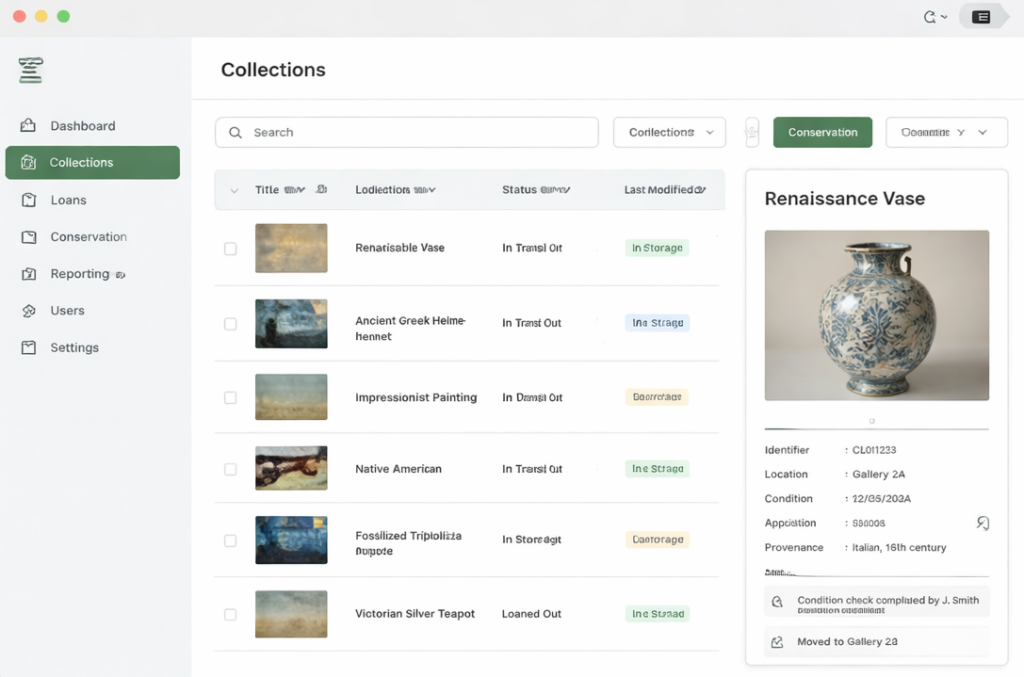
Create and maintain structured records for artworks, objects, archive items, and related materials in a centralized database tailored to your institution’s needs.
- Comprehensive cataloguing fields
- High-resolution images linked to each record
- Detailed provenance tracking
Loan Management
Track inbound and outbound loans with clear record history, supporting documentation, and better visibility into object movement and loan-related activity.
- Inbound and outbound loan tracking
- Supporting documentation for every loan
- Clear object movement history
Restoration and Conservation Tracking
Record restoration history, conservation work, condition-related notes, and timeline-based updates as part of the object’s long-term documentation.
- Restoration and treatment history
- Condition-related notes
- Timeline-based updates
Search, Filtering, and Full Record History
Find records quickly, filter data based on relevant criteria, and maintain full historical visibility across updates, changes, and documentation entries.
- Fast search across all records
- Filters by any relevant criteria
- Complete history of every change
Labeling, Grouping, and Metadata Control
Organize records with institution-specific structures, labels, groupings, and metadata fields that reflect how your collection is actually managed.
- Institution-specific metadata fields
- Custom labels and groupings
- Structures that match your collection
Reporting and Time-Period Statistics
Generate useful overviews and statistics across selected time periods to support internal reporting, planning, and institutional analysis.
- Statistics for selected time periods
- Overviews for internal reporting
- Data for planning and analysis
Support for Image, Video, Audio, Documents, and 3D Files
Store and manage a wide range of digital assets connected to each record, including visual, written, audio, video, and 3D materials.
- Images, video and audio
- Documents and 3D files
- Every asset linked to its record
Role-Based Access and Permissions
Control who can access, edit, or review different types of data, helping teams work securely and with the right level of visibility.
- Access defined by role
- Separate view, edit and review rights
- Secure handling of sensitive data
Add Your Heading Text Here
Lorem ipsum dolor sit amet, consectetur adipiscing elit. Ut elit tellus, luctus nec ullamcorper mattis, pulvinar dapibus leo.
- Comprehensive cataloguing fields
- High-resolution image composition
- Detailed provenance tracking
Implementation, Migration, and Ongoing Support
Institutional software should not create unnecessary disruption. Archive for Art is supported by a structured implementation process designed to help institutions move into the platform with clarity and confidence.
1. Consultation and Workflow Review
We begin by understanding your institution’s structure, workflows, record types, and practical requirements so the platform can be aligned to real operational needs.

2. Data Migration
Existing records and documentation can be reviewed and transferred into the new system through a structured migration process.
3. Staff Training
Your team receives the guidance needed to use the platform effectively, whether for day-to-day record handling, reporting, or public-facing workflows.
4. Go-Live Support
We support the rollout process to help ensure a smoother transition and a more confident adoption of the system.
5. Ongoing Assistance and Updates
Support continues beyond implementation with updates, technical assistance, and service options based on your institution’s chosen package.
Built for Institutional Accountability
Archive for Art is not only about storing data. It is about helping institutions manage collections with greater structure, traceability, and confidence.
Better Documentation Integrity
Keep records more consistent, complete, and easier to maintain over time across departments and use cases.
Improved Traceability Across the Collection Lifecycle
Follow the history of an object, record, loan, or restoration process with clearer documentation and better oversight.
Reduced Administrative Overhead
Centralizing records and workflows makes it easier to reduce repetitive manual work and improve operational efficiency.
Clearer Oversight for Teams and Decision-Makers
Provide staff and leadership with more reliable access to the information they need for reporting, planning, and day-to-day work.
Stronger Coordination Across Departments
A shared system helps teams work from the same record base instead of relying on disconnected files, informal updates, or duplicate documentation.
Flexible Pricing for Different Institutional Needs
One-Time Purchase
A perpetual license installed on your own servers, with one year of updates included.
- Installed on your own servers
- 12 months of updates included
- 3 support requests per month
Service-Based Subscription
A monthly subscription, hosted and maintained by us, so you are always on the latest version.
- Hosted and maintained by us
- Always on the latest version
- 6 support requests per month
Enterprise Plan
Deployment, support and terms arranged around your institution’s specific requirements.
- Hosted or on-premise
- Support terms set by agreement
- Dedicated point of contact
See How Archive for Art Fits Your Institution
Whether you manage a museum collection, gallery records, archive materials, or exhibition-related documentation, Archive for Art can be adapted to support your workflow. Book a demo to see how the platform can help your institution centralize records, improve visibility, and manage collection data with greater control.